


IELTS Speaking mistakes are usually small, and most of them can be fixed with the right kind of practice. Very few candidates lose marks because their English is too weak. It’s more to do with losing marks because of unhelpful habits: answers that are too short, sentences learned by heart, or silence when nerves take over.
Indeed, nerves change how people speak. Some speak much too fast, and some go quiet. I for one am guilty of both; how about you? Then there are those who suddenly remember a perfect sentence they memorised last week and use it for the wrong question. None of this means you are a weak speaker. It means the test is stressful, and you need a few tools.
This post explains seven of the most common mistakes and gives you a practical fix for each one. It’s written for adults preparing for the test, including students in Hong Kong who study English with us on our General English courses, which can include exam preparation.
Last updated: October 2026. Check the official IELTS website for the latest test rules and format.
Table of Contents
- The short answer
- How the IELTS Speaking test works
- Seven common IELTS Speaking mistakes
- A simple two-week practice plan
- On the day of the test
- Getting help with IELTS Speaking
- FAQ: IELTS Speaking
The short answer
The most common IELTS Speaking mistakes are giving very short answers, memorising scripts, losing structure in the Part 2 talk, staying too personal in Part 3, stopping to make every sentence perfect, using difficult words you do not control, and ignoring stress and intonation. The fix is the same each time: answer the question that was asked, add a reason or example, and keep talking in a natural way.
How the IELTS Speaking test works
The IELTS Speaking test is a one-to-one conversation with an examiner. It lasts 11 to 14 minutes and has three parts, according to the official IELTS website.
- Part 1: introduction and interview (4 to 5 minutes). The examiner asks general questions about familiar topics such as home, work, study and interests.
- Part 2: the long turn. You receive a topic card and have one minute to prepare notes. Then you speak for about two minutes, and the examiner may ask one or two short follow-up questions.
- Part 3: discussion (4 to 5 minutes). You discuss more general and abstract ideas connected to the Part 2 topic.
Your speaking is marked on four criteria: fluency and coherence, vocabulary (lexical resource), grammatical range and accuracy, and pronunciation. Keep these four in mind, because each mistake below connects to at least one of them.
Seven common IELTS Speaking mistakes
Mistake 1: Giving very short answers
It’s easy to answer a simple question with a simple answer. “Do you work or study?” “I work.” That is true, but it gives the examiner almost nothing to assess.
The fix: answer directly, then add a reason or a short example. Two or three sentences is a good target in Part 1. For example: “I work in marketing. I like it because every day is different, although the hours can be long.” Do not make a long speech either. You are having a conversation, not giving a lecture.
Mistake 2: Using memorised answers
Learning ready-made answers feels safe. The risk is that examiners are trained to notice rehearsed language, and a memorised answer can lower your score. It also fails when the question is slightly different from the one you practised.
The fix: practise ideas, not scripts. For each common topic, such as work, study, hometown, food and free time, prepare three or four ideas and some useful vocabulary. Then practise saying them in different ways, so the words come out fresh each time.
Mistake 3: Losing structure in Part 2
Two minutes is a long time to talk alone. Candidates often stop after a minute, because they’ve run out of ideas, or they jump between points without a clear order.
The fix: use your one minute of preparation to write a few key words, not full sentences. A simple structure works for most topics. Say what or who it’s, where and when it happened, what happened, and why it mattered to you. If the topic is “Describe a place you like to visit”, you might note: place, last visit, what I did, why I like it. If you finish early, add a feeling, a detail or a comparison. If you lose your place, return to your notes and carry on.
Mistake 4: Staying too personal in Part 3
Part 3 questions move from your own life to wider ideas. For example: “Why do people travel?” Many candidates keep answering with “I”, and say “I like to travel because it’s fun”. That is a valid start, but it does not show that you can discuss an idea.
The fix: move from the personal to the general. Try this pattern: give your opinion, give a reason, and then add an example or a contrast. “I think many people travel to relax. Work can be stressful, and a change of place helps them forget it. On the other hand, some people travel to learn about other cultures.” Phrases like “many people”, “on the other hand” and “it depends on” help.
Mistake 5: Stopping to make every sentence perfect
Many careful learners pause for a long time because they want the perfect word or the perfect grammar. The pause itself then becomes the problem, because it damages your fluency. Perfect English is not required. Natural, understandable English with a good range is.
The fix: keep going. If you cannot find a word, explain it in simple words: “the thing you use to…”. If you make a small mistake, correct it quickly and continue. Short natural phrases such as “Let me think” or “That is an interesting question” give you a few seconds, but do not use them in every answer. Also try to use a mix of simple and longer sentences, and talk about past, present and future when the question allows it. Do not avoid all risk.
Mistake 6: Using difficult words you do not control
A large word used in the wrong way is worse than a simple word used well. Candidates sometimes learn lists of impressive vocabulary and then place it into answers where it does not fit.
The fix: build a smaller, stronger vocabulary for common topics. Learn words in phrases, not alone, because phrases tell you how a word is used. Say each new phrase aloud in a real sentence about your own life. After that, use it in practice. A few precise words that you know well will help more than many words you half-know.
Mistake 7: Ignoring stress and intonation
Pronunciation is not only about individual sounds. Flat delivery, where every word has the same weight and the voice stays at the same pitch, is hard to listen to for 11 minutes. It can also hide the meaning of what you say.
The fix: stress the important words in a sentence, and let your voice rise and fall naturally. Record yourself answering a question, listen once, and notice where the sentence sounds flat or rushed. You do not need to remove your accent. You need to be easy to understand. Our guide to improving English pronunciation has practical tips.
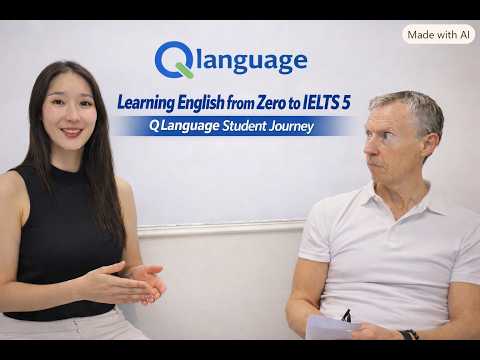
From Zero English to IELTS 5 in Just a Year – a Q Language Student Journey
Here’s a short YouTube video featuring one of our English teachers, Derek, and his student Tiffany.
Tiffany moved to Hong Kong with virtually no English and initially felt nervous and anxious about studying English. However, after just six months of study at Q Language, she became much more confident speaking English with people outside class, even when she made mistakes.
She credits her family and teachers for supporting and encouraging her. After just over a year of learning, she achieved a score of five in the IELTS exam. Her next goal is to achieve a score of 7.5.
A simple two-week practice plan
You do not need hours every day. Short, regular practice works better than one long session. Here is a simple plan you can adapt.
- Days 1 to 3: Choose three Part 1 topics, such as work, hometown and free time. Answer five questions on each, aloud, with a reason or example. Record one answer.
- Days 4 to 6: Practise Part 2. Choose a topic card, prepare for one minute using key words only, and speak for two minutes. Use a timer. Listen back and note where you stopped or repeated yourself.
- Day 7: Rest, or watch a short interview or talk in English and notice how people link their ideas.
- Days 8 to 10: Practise Part 3. Take each Part 2 topic from last week and ask yourself two general questions about it. Use the pattern: opinion, reason, example.
- Days 11 to 13: Do a full practice test in one go. Try to do it with a teacher or a friend who can give you feedback, not just a recording.
- Day 14: Review your recordings and choose one mistake to focus on next.
Progress takes time, and it’s different for each person. For a realistic idea of timing, see our guide to how long it takes to improve your English.
On the day of the test
- Check your booking details. The Speaking test may take place on a different day from the other parts, so look at your confirmation carefully, and ask the test centre if you are unsure.
- Bring the identification you registered with. The examiner will check it.
- Warm up. Speak English for ten minutes before the test, for example by answering a few practice questions aloud.
- Ask if you do not understand. It’s acceptable to ask the examiner to repeat a question.
- Do not worry about a mistake that has already happened. Move on to the next answer. Examiners listen to the whole test, not to one error.
Getting help with IELTS Speaking
If you are not sure how strong your English is, start with our free level test. Our guide to finding your English level explains how it works. Many exam students combine a group course with private one-to-one sessions that focus on their exam, and our page on one-to-one and small group classes explains how private lessons work. If you are also preparing for the Writing paper, see our guide to how to ace the IELTS Writing exam.
To ask about IELTS preparation, message us on WhatsApp or contact us. We are at 14/F Wing On Cheong Building, 5 Wing Lok Street, Central.
FAQ: IELTS Speaking
1. How many parts are there in the IELTS Speaking test?
There are three: an interview about familiar topics, a short talk on a topic card, and a discussion of related, more abstract ideas. The whole test takes 11 to 14 minutes.
2. How long should my answers be in Part 1?
Two or three sentences is a good target. Answer the question directly, then add a reason or a short example. Avoid one-word answers, and avoid long speeches.
3. Can I use memorised answers in IELTS Speaking?
It’s risky. Examiners are trained to notice rehearsed language, and memorised answers can lower your score. Practise ideas and structures instead of full scripts.
4. What should I do if I do not know a word in the Speaking test?
Explain the idea in simple words, for example “the thing you use to…”, and keep going. Stopping for a long time hurts your fluency more than using a simple description.
5. Do I need to speak for the full two minutes in Part 2?
You should try to. You get one minute to prepare notes, and you then speak for about two minutes. Use your notes to keep a clear order, and add a feeling, a detail or a comparison if you finish early.
6. What are the four marking criteria in IELTS Speaking?
They are fluency and coherence, vocabulary (lexical resource), grammatical range and accuracy, and pronunciation.
7. Does Q Language offer IELTS preparation?
Yes. Many exam students combine a group course with private one-to-one sessions that focus on their exam. Contact us to discuss your level, your test date and your target score.


